Cherry Shrimp
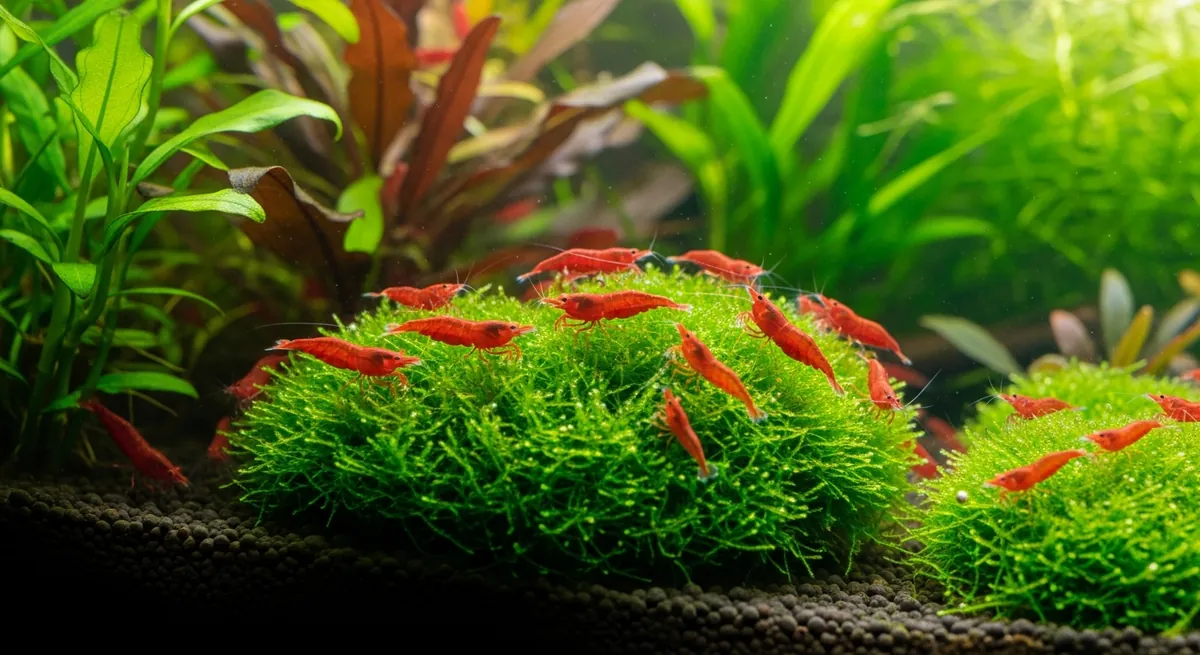
Cherry shrimp (Neocaridina davidi) are hardy, peaceful invertebrates that thrive in a stable, planted tank of 5 gallons or more with steady GH/KH. They graze biofilm, breed readily, and a colony self-regulates to its food supply.
Cherry shrimp at a glance
- Scientific name
- Neocaridina davidi
- Adult size
- ~0.6″
- Temperature
- 65–80°F
- pH
- 6.5–8
- Minimum tank
- 5 gal
- Temperament
- peaceful
- Social
- schooling — keep 6+
- Reference
- Wikipedia
The cherry shrimp (Neocaridina davidi) is the easiest freshwater shrimp to keep: hardy, peaceful, and colorful. It spends the day grazing biofilm off plants and hardscape, and in stable water it breeds without any help.
Tank and water
Cherry shrimp need a stable, planted tank of at least 5 gallons. Across 390 real shrimp tanks in the AquaGauge dataset (July 2026 snapshot), the median is 6 gallons and 87% are 5 gallons or larger (the full size breakdown). What matters most is not the number on a test kit but its steadiness: keep GH around 6-8, KH 2-4, and a steady temperature. See the full water parameter breakdown from 172 real shrimp tanks for verified medians. Small tanks swing fast, and fast swings cause failed molts (see why shrimp die after water changes for the data and molting problems for prevention). A sponge filter is ideal because it will not trap shrimplets.
Diet
They graze biofilm and algae off surfaces all day, so an established, planted tank feeds most of the colony. Supplement lightly with a shrimp food, blanched spinach or zucchini, and botanicals like catappa leaves. Feed small amounts a few times a week. Overfeeding fouls the water faster than it helps.
Temperament and tankmates
Cherry shrimp are peaceful and defenseless. The whole question is what will eat them. They are safest in a shrimp-only tank, or with small, calm fish that cannot fit a shrimp in their mouth. The compatible and risky tankmates (from our compatibility model) are listed below, and you can check a mixed plan in how many shrimp per gallon.
Breeding and colony size
A healthy colony self-regulates. Add a starter group of 10 or so, keep the water stable, and the population grows to fill the available food and biofilm, then holds there. There is no hard per-gallon cap the way there is with fish.
Compatible tankmates for Cherry shrimp
Generated from our compatibility model — temperament, fin-nipping, temperature overlap and predation. Run your exact plan in the calculator below.
Good companions:Neon tetra, Ember tetra, Cardinal tetra, Harlequin rasbora, Guppy, Endler's livebearer, Platy, White cloud minnow, Corydoras catfish, Pygmy corydoras, Panda corydoras, Bronze corydoras, Sterbai corydoras, Peppered corydoras, Julii corydoras, Otocinclus, Kuhli loach, Nerite snail, Mystery snail.
With care:Molly, Zebra danio, Dwarf gourami, Tiger barb, Serpae tetra, Bristlenose pleco, Common pleco — workable in a planted tank, but watch them.
Avoid:Betta, Angelfish, Goldfish.
Plan a Cherry tank
Start with the centerpiece and check stocking, filtration and compatible tankmates — live.
Planning a Cherry shrimp tank. We start with your cherry shrimp and filter the list to compatible tankmates — untick to see every species (incompatible ones get flagged).
Stocking — under 85% comfortable · 85–100% full · over 100% overstocked
Show the math
FAQ
- What tank size do cherry shrimp need?
- Five gallons is the practical minimum and the most common size keepers use. Across 390 real shrimp tanks in the AquaGauge dataset, the median is 6 gallons and 87% are 5 gallons or larger. Small water columns swing in chemistry, which is what kills shrimp.
- What do cherry shrimp eat?
- Mostly biofilm and algae they graze off surfaces. Supplement lightly with a shrimp-specific food, blanched vegetables, and occasional botanicals. Overfeeding, not underfeeding, is the common mistake.
- Are cherry shrimp easy to breed?
- Yes. In stable, planted water a colony breeds on its own with no intervention. The population grows to match the tank's food and biofilm, then levels off.
- What water parameters do cherry shrimp need?
- Stable, moderately hard water matters most: keep GH around 6–8 and KH 2–4, with steady temperature. Neocaridina are tolerant of a pH range but hate swings.

Freshwater aquarist of 8+ years.