Betta Fish
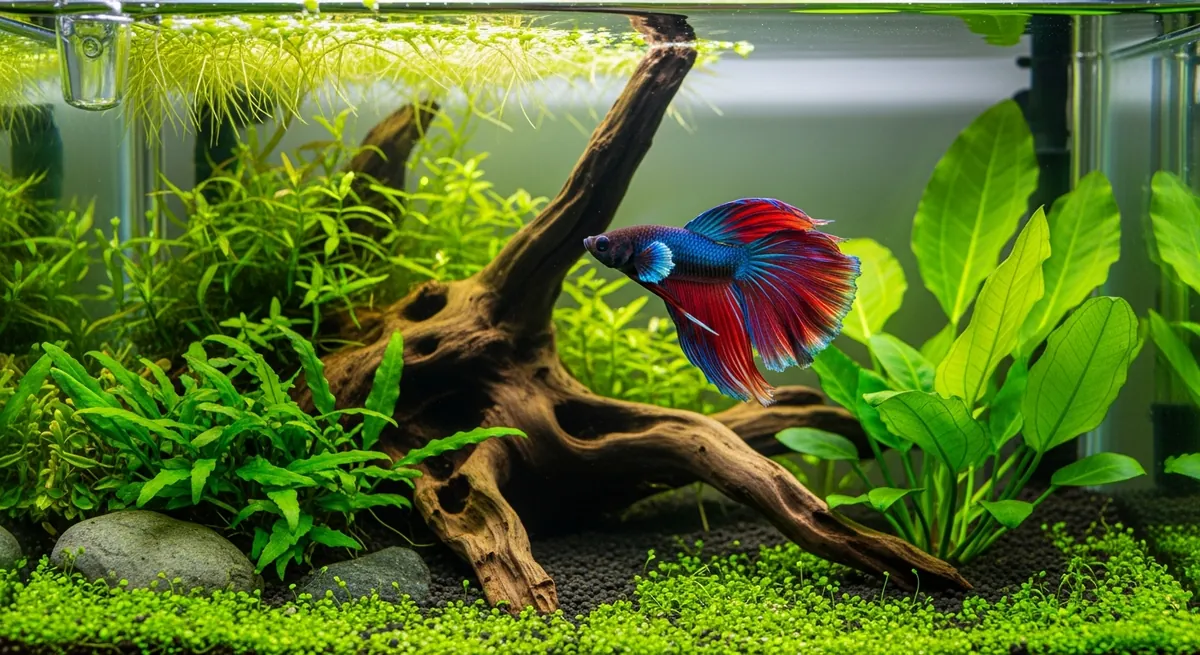
A betta (Betta splendens) is a tropical labyrinth fish that needs a heated, filtered tank of at least 5 gallons, water at 78–80°F and pH near 7, and a meat-based diet. Males are territorial and kept alone or with a few careful tankmates.
Betta at a glance
- Scientific name
- Betta splendens
- Adult size
- ~2.5″
- Temperature
- 76–82°F
- pH
- 6.5–7.5
- Minimum tank
- 5 gal
- Temperament
- aggressive
- Social
- can be kept singly
- Reference
- Wikipedia
The betta (Betta splendens), or Siamese fighting fish, is a tropical labyrinth fish from the slow waters of Southeast Asia. It breathes air at the surface, which is why it survives in tiny containers in stores. Surviving is not thriving: a betta needs a heated, filtered tank to live a full life.
Tank and water
A betta needs at least 5 gallons, heated to 78–80°F, with a gentle filter. Across 542 real betta tanks in the AquaGauge dataset (July 2026 snapshot), the median is 10 gallons and 92% are 5 gallons or larger. Keep pH near neutral (6.5–7.5); stable water matters more than a perfect number. The reference database FishBase documents a tolerance range of 24–30°C and pH 6.0–8.0 for Betta splendens.2 See the full data in what size tank does a betta need, a head-to-head in 5-gallon vs 10-gallon betta tank, and safe ammonia & nitrate levels from 125 tanks.
Diet
Bettas are carnivores. A quality betta pellet is the staple, with frozen or live bloodworms and brine shrimp for variety. Feed a small amount once or twice a day, and skip a day a week. They do not eat flake meant for community fish well, and they cannot live off plant roots.
Temperament and tankmates
A male betta is territorial. It is kept alone, or with a few calm, non-fin-nipping tankmates in 10 gallons or more — bottom and mid dwellers that ignore it, never fin-nippers or bright long-finned fish. The compatible and incompatible species (from our compatibility model) are listed below. Plan a specific tank in what fish can live with bettas. Seriously Fish puts it bluntly: ornamental bettas are “best kept alone” and “not recommended for the standard community aquarium.”3 The classic aquarium author William T. Innes made the same point a century ago: “Betta, the Siamese Fighting-fish, can be kept with other fishes as it fights only its own kind.”1 Two males, though, cannot share a tank: “Unfortunately males cannot be left together, as they tear each other’s fins badly.”1
Lifespan and health
A well-kept betta lives 3 to 5 years. Most early deaths trace to cold or unstable water (no heater), an uncycled tank, or overfeeding. A heater, a filter, a cycled tank, and a varied diet cover the basics.
Varieties
Bettas are sold in many fin and color forms: veiltail, halfmoon, crowntail, and plakat (short-finned), among others. The care is the same across forms; long-finned types are more prone to fin damage from sharp decor or strong flow.
Compatible tankmates for Betta
Generated from our compatibility model — temperament, fin-nipping, temperature overlap and predation. Run your exact plan in the calculator below.
Good companions:Neon tetra, Ember tetra, Cardinal tetra, Harlequin rasbora, Endler's livebearer, Platy, Molly, Corydoras catfish, Pygmy corydoras, Bronze corydoras, Sterbai corydoras, Peppered corydoras, Julii corydoras, Otocinclus, Kuhli loach, Nerite snail, Mystery snail, Bristlenose pleco, Common pleco.
With care:Cherry shrimp — workable in a planted tank, but watch them.
Avoid:Guppy, Zebra danio, Dwarf gourami, Tiger barb, Serpae tetra, Angelfish, Discus, Goldfish, and other bettas.
Plan a Betta tank
Start with the centerpiece and check stocking, filtration and compatible tankmates — live.
Planning a Betta tank. We start with your betta and filter the list to compatible tankmates — untick to see every species (incompatible ones get flagged).
Stocking — under 85% comfortable · 85–100% full · over 100% overstocked
Show the math
FAQ
- How long do betta fish live?
- Most bettas live 3 to 5 years with a heated, filtered, cycled tank and a varied diet. Poor conditions (a bowl, no heater) cut that short.
- What do betta fish eat?
- Bettas are carnivores. Feed a betta-specific pellet as the staple, plus frozen or live foods like bloodworms and brine shrimp. They cannot live on plant roots or 'betta plants' alone.
- Do betta fish need a heater and filter?
- Yes, both. Bettas are tropical and need a stable 78–80°F, which means a heater, and a gentle filter to keep ammonia down. A bowl with neither is not adequate.
- Can betta fish live together?
- No. Two males fight, often to the death. A male is kept alone or with a few peaceful, non-fin-nipping tankmates in 10 gallons or more.
Sources
- The Complete Aquarium Book.
- Betta splendens, Siamese fighting fish, FishBase. View source ↗
- Betta splendens, Seriously Fish. View source ↗

Freshwater aquarist of 8+ years.