Pleco (Plecostomus) Care
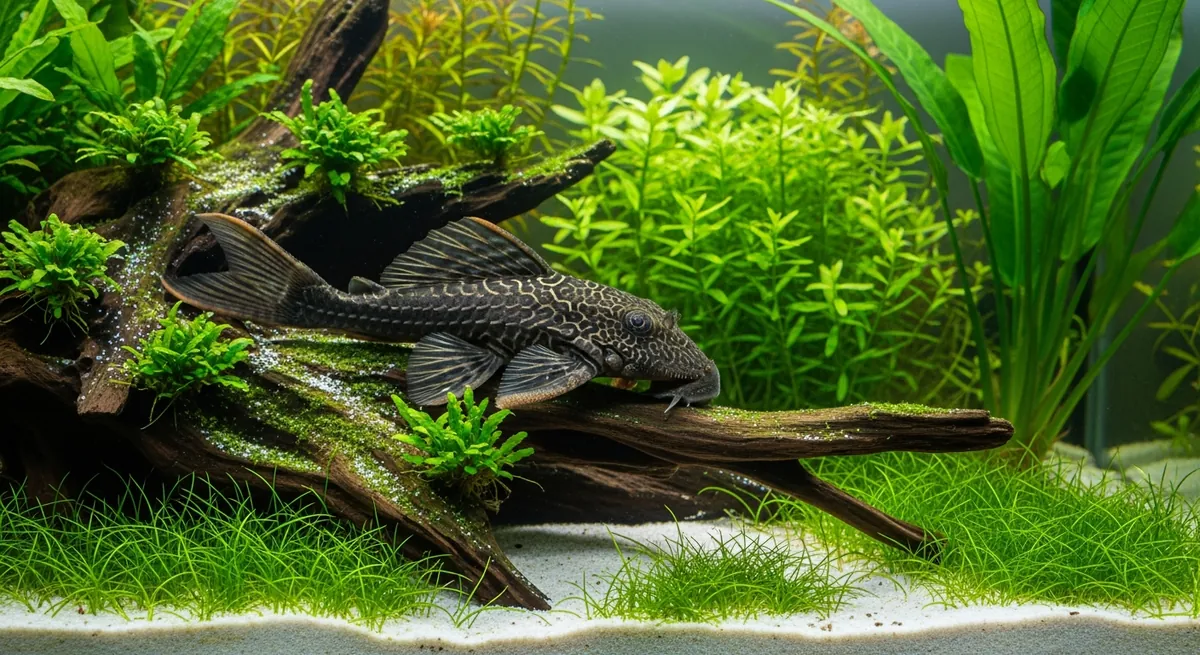
"Pleco" covers many species. The one to buy is the bristlenose (Ancistrus): it stays 4-5 inches and thrives in a 20-gallon. Avoid the common pleco (Hypostomus) unless you have 75+ gallons; it reaches 18-24 inches. Both are hardy, driftwood-loving, air-breathing algae grazers that still need real food.
Bristlenose pleco at a glance
- Scientific name
- Ancistrus sp.
- Adult size
- ~5″
- Temperature
- 70–79°F
- pH
- 6–7.5
- Minimum tank
- 20 gal
- Temperament
- peaceful
- Social
- can be kept singly
- Reference
- Wikipedia
“Pleco” is not one fish. It is a common name for dozens of suckermouth catfish, and the single most important care decision is which one you buy. The two you will meet in shops could not be more different: the bristlenose stays small enough for a normal tank, and the common pleco grows into a monster.
Bristlenose vs common pleco at a glance
| Attribute | Bristlenose (Ancistrus) | Common pleco (Hypostomus) |
|---|---|---|
| Adult size | 4-5 in (10-12.5 cm)1 | 18-24 in (up to ~60 cm)3 |
| Minimum tank | 20 gallons | 75-125 gallons |
| Temperament | Peaceful | Peaceful, but enormous |
| Diet | Omnivore: algae + veg + protein1 | Same diet, far more waste |
| Best for | Almost every home aquarium | Only very large tanks or ponds |
Ranges from Seriously Fish and FishBase. The "pleco" sold cheaply as an algae eater is usually a common pleco, so check the species before you buy.

"Quite an easy species to keep as long as there is adequate aeration in the aquarium and giving them a choice of pipes, stones or rockwork."
Which pleco should you actually get?
For nearly every home aquarium, the answer is the bristlenose pleco. It does the algae-grazing job people want a pleco for, stays 4-5 inches, and is happy in a 20-gallon.1 The common pleco reaches 18-24 inches and needs a 75-125-gallon tank; most are sold small and cheap, outgrow their tank within a year or two, and end up rehomed or worse.3 If a shop just labels a tank “pleco,” ask which species it is before buying, and size the tank with the pleco tank-size guide.
Do plecos need driftwood?
Effectively yes. Plecos rasp on wood and graze the biofilm it grows, which helps their digestion, and it gives them the daytime cover they want. A pleco can survive without it, but it does noticeably better with a piece of driftwood in the tank, so treat it as a first purchase, not an optional extra.
Do they really eat algae?
Plecos graze algae and biofilm, but they cannot live on it alone. A pleco is an omnivore that needs a varied diet: algae wafers, vegetables (cucumber, courgette), and some protein such as sinking pellets and the occasional frozen treat.14 The most common pleco mistake is buying one as a self-cleaning “algae eater” and slowly starving it once the tank’s algae runs out. Whatever the species, they are also heavy waste producers, so plan for the bioload and keep the water clean.
Lifespan and breeding
Both are long-lived: a well-kept bristlenose commonly lives 5-12 years, and a common pleco can live well over a decade. Bristlenose breed famously easily. They are cave-spawners: a male claims a cave, the female lays inside, and the male guards and fans the eggs, so in a mature tank juveniles often appear without any intervention.4 Common plecos, by contrast, are almost never bred in home aquaria because of their size.
Pleco care guides
- Bristlenose pleco care covers the small, hardy pleco to buy: tank size, driftwood, diet, and breeding.
- What size tank does a pleco need? compares bristlenose vs common, with real setups.
Compatible tankmates for Bristlenose pleco
Generated from our compatibility model — temperament, fin-nipping, temperature overlap and predation. Run your exact plan in the calculator below.
Good companions:Neon tetra, Ember tetra, Cardinal tetra, Harlequin rasbora, Guppy, Endler's livebearer, Platy, Molly, Zebra danio, White cloud minnow, Corydoras catfish, Pygmy corydoras, Panda corydoras, Bronze corydoras, Sterbai corydoras, Peppered corydoras, Julii corydoras, Otocinclus, Kuhli loach, Dwarf gourami, Tiger barb, Serpae tetra, Angelfish, Goldfish, Cherry shrimp, Nerite snail, Mystery snail, Common pleco.
Avoid:Betta.
Plan a Pleco tank
Start with the centerpiece and check stocking, filtration and compatible tankmates — live.
Planning a Bristlenose pleco tank. We start with your bristlenose pleco and filter the list to compatible tankmates — untick to see every species (incompatible ones get flagged).
Stocking — under 85% comfortable · 85–100% full · over 100% overstocked
Show the math
FAQ
- Which pleco is best for a home aquarium?
- The bristlenose pleco (Ancistrus). It stays 4-5 inches and thrives in a 20-gallon tank, unlike the common pleco (Hypostomus), which reaches 18-24 inches and needs 75 gallons or more. For nearly every home aquarium, buy a bristlenose.
- How big do plecos get?
- It depends entirely on the species. A bristlenose stays 4-5 inches; a common pleco reaches 18-24 inches. Always check which species a shop is selling, because a cheap 'algae eater' pleco is often a common pleco that will outgrow the tank.
- Do plecos need driftwood?
- Effectively yes. Plecos rasp on wood and graze the biofilm it grows, which aids digestion, and it gives them daytime cover. A piece of driftwood is one of the first things to add, not an optional extra.
- Do plecos really eat algae?
- They graze algae and biofilm but cannot live on it alone. A pleco is an omnivore that needs algae wafers, vegetables, and some protein. Buying one purely as a self-cleaning 'algae eater' slowly starves it once the tank's algae runs out.
- Do plecos need an air pump?
- Not specifically, but they need well-oxygenated, clean water. Plecos are facultative air-breathers that take occasional gulps from the surface, so make sure the surface is reachable and the water is well-filtered.
Sources
- Ancistrus sp. '3' (Common Bristlenose Catfish), Seriously Fish. View source ↗
- Ancistrus cirrhosus (Bristlenose), FishBase. View source ↗
- Hypostomus plecostomus (Suckermouth catfish), FishBase. View source ↗
- ScotCat catfish factsheets (Ancistrus), ScotCat (electronic publication) (2025). View source ↗

Freshwater aquarist of 8+ years.