What Size Tank for a Planted Aquarium?
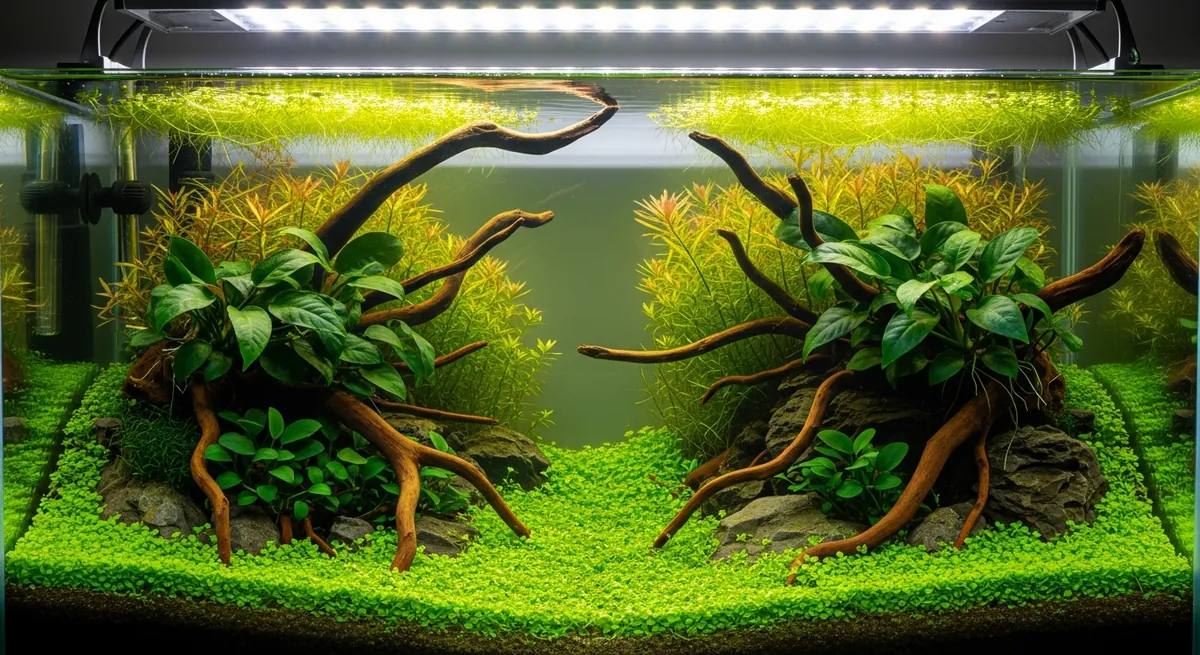
Short answer: 20 gallons. Across 436 real planted tanks from r/PlantedTank, the median is 20 gallons, matching the median across 5,134 general freshwater setups. 61% run larger than 10 gallons.
20 gallons. Across 436 real planted tanks posted to r/PlantedTank in the AquaGauge dataset (July 2026 snapshot), the median size is 20 gallons. That matches the 20-gallon median for general freshwater setups (n = 5,134). The middle 50% of planted tanks fall between 10 and 40 gallons, and 61% are larger than 10 gallons.
What real keepers actually use
| Size bracket | % of 436 tanks |
|---|---|
| Under 5 gal | 3% |
| 5 gal | 12% |
| 6-9 gal | 6% |
| 10 gal | 18% |
| Over 10 gal | 61% |
Summary stats (AquaGauge dataset, n = 436): median 20 gal, mean 36.8 gal, Q1 10, Q3 40, range 1-1,200 gal.
The mean (36.8 gal) sits well above the median (20 gal) because a handful of large aquascapes (up to 1,200 gallons) pull it up. The median better represents a typical planted setup.
97% of planted tanks are 5 gallons or larger. Only 3% go below 5 gallons, compared to 4% in the general freshwater dataset.
Why plants favor bigger tanks
Three things push planted keepers toward larger tanks:
-
Substrate depth. Rooted plants need 2-3 inches of substrate. In a shallow nano tank, that eats a third of the water column. A 20-gallon long (12 inches tall) still leaves 9+ inches above the substrate line.
-
Light and vertical space. Stem plants grow tall. Carpeting plants need strong, even light that reaches the bottom. Deeper tanks give stems room to fill in, and a standard 20-gallon is wide enough for uniform light coverage from a single LED bar.
-
Stability. More water dilutes CO2, nutrient, and temperature swings. Plants consume ammonia and nitrate directly, which helps the nitrogen cycle, but they also shift pH as they photosynthesize (consuming CO2 during the day, releasing it at night). A larger water volume buffers those daily swings. As Innes noted about planted aquariums generally, “Three sides of the aquarium should be planted somewhat closely” to maintain water quality.1 The principle holds: more plants need more tank.
Planted aquariums also act as biological filters. Aquatic plants assimilate dissolved inorganic nitrogen (ammonia and nitrate) directly through leaves and roots, reducing the load on the bacterial filter.2 That nitrogen uptake is why heavily planted tanks often read lower nitrate than bare setups, and it is one reason planted keepers can stock slightly more fish per gallon than the raw numbers suggest.
The 20-gallon sweet spot
The 20-gallon long is the workhorse of the planted hobby. It is cheap, fits a standard stand or dresser, and its footprint (30 x 12 inches) accommodates a full aquascape with foreground, midground, and background zones. It is large enough for pressurized CO2 to be worthwhile, but small enough that a single bag of active substrate covers the bottom.
If you want a community on top of the plants, 20 gallons supports a school of neon tetras, a group of corydoras, or a shrimp colony without crowding the layout.
When a nano planted tank works
12% of planted tanks in the data are 5 gallons. Nano planted setups work when you stick to plants that tolerate low-to-medium light and do not need deep substrate:
- Java fern and Anubias tied to driftwood or rock (no substrate needed)
- Java moss or Christmas moss draped over hardscape
- Bucephalandra attached to stone
Skip demanding carpeting plants (dwarf baby tears, Monte Carlo) in a 5-gallon unless you run CO2 and high light. The margin for error in a nano is thin: a missed water change or a cloudy day near the window shifts pH more than it would in a 20.
How we counted
We analyzed 436 planted tanks posted to r/PlantedTank where keepers reported tank volume in gallons. All numbers on this page come from those reports, verified by verify_stats.py. For comparison, the general freshwater dataset (n = 5,134) covers all subreddits.
Example source posts:
Use the volume calculator to convert your tank dimensions to gallons.
Figures are from the July 2026 snapshot (6,414 tanks total).
Check your exact stocking
Add your fish below to see stocking %, filtration load and compatibility for your setup — live.
Stocking — under 85% comfortable · 85–100% full · over 100% overstocked
Show the math
Gear for this setup
As an Amazon Associate AquaGauge earns from qualifying purchases. Some links below are affiliate links, at no extra cost to you. Current price and availability are shown on Amazon. Disclosure.
 Fluval Plant and Shrimp Stratum (8.8 lb)Active substrate that buffers pH slightly acidic and gives roots a porous medium to grip. Sized for the median 20-gallon planted tank.Check price on Amazon →
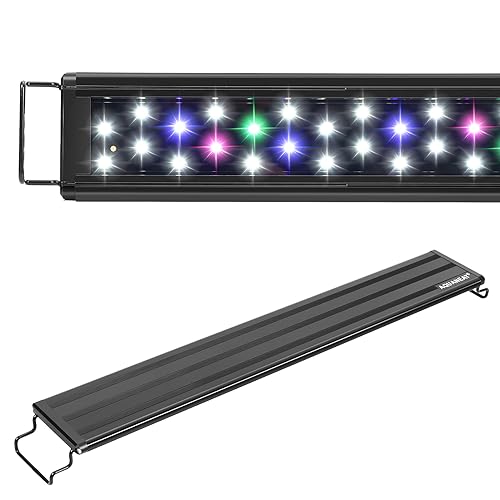 AQUANEAT LED Aquarium Light (18-24 in)Full-spectrum LED that fits a standard 20-gallon long. Enough PAR for low-to-medium light plants without a CO2 setup.Check price on Amazon →
FAQ
- What is the best tank size for a planted aquarium?
- 20 gallons. That is the median across 436 real planted tanks. It gives enough depth for rooted plants, room for hardscape, and stable water chemistry. 79% of planted tanks are 10 gallons or larger.
- Can you have a planted tank in 5 gallons?
- Yes. 12% of planted tanks in our data are 5 gallons. Nano planted tanks work well with low-light plants like Java fern, Anubias, and mosses. Skip stem plants that need deep substrate and strong light.
- Why are planted tanks bigger than regular fish tanks?
- Plants need substrate depth (2-3 inches minimum for roots), vertical space for stems and lighting, and enough water volume to buffer CO2 and nutrient swings. All of that favors larger tanks.
- Is a 10-gallon tank big enough for a planted aquarium?
- It works. 18% of planted tanks in our data are exactly 10 gallons. A 10-gallon handles easy plants, a basic light, and root tabs. For demanding carpeting plants or pressurized CO2, most keepers step up to 20 gallons.
Sources
- The Complete Aquarium Book, Halcyon House. View source ↗
- Nitrogen and Water Quality, URI Cooperative Extension (2005). View source ↗

Freshwater aquarist of 8+ years.