How Often Should You Change Aquarium Water?
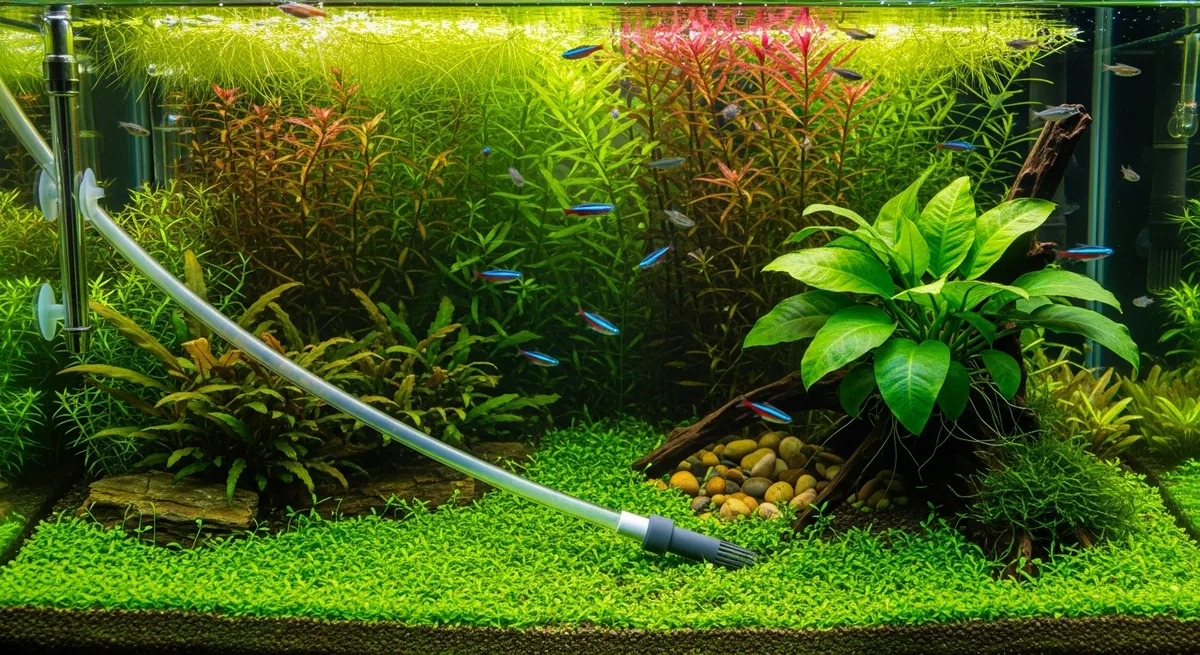
Short answer: Let nitrate, not the calendar, set your water change schedule. Across 1,015 real tanks, the median nitrate is 10 ppm and 83% stay at or under 20 ppm. Most keepers change water when nitrate climbs, not on a fixed day.
Let nitrate tell you when to change water, not the calendar. Across 1,015 real freshwater tanks in the AquaGauge dataset (July 2026 snapshot), the median nitrate reading is 10 ppm and 83% of tanks stay at or under 20 ppm. Keepers who test and change water when nitrate climbs keep their tanks healthier than those following a rigid weekly schedule.
This is not a new idea. The classic aquarium author William T. Innes called it the beginner’s most common question: “‘How Often Must I Change the Water?’ … is truly the commonest [question of the beginner]. He seems to expect a reply such as ‘every day’, ‘once a week’ or ‘once a month’. There should be no such answer.”1
What real tanks actually read
We pulled nitrate readings from 1,015 tanks posted across 12 aquarium subreddits, including r/Aquariums, r/PlantedTank, r/bettafish, and r/shrimptank. Here is what the numbers look like:
| Nitrate range | % of tanks |
|---|---|
| 20 ppm or below | 83% |
| Over 40 ppm | 6% |
Median: 10 ppm. The middle half of tanks (interquartile range) sit between 0.5 and 20 ppm. The mean is 16.2 ppm, pulled up by a small tail of neglected tanks — the highest reading in the dataset is 400 ppm.
The takeaway: most keepers who bother to test already keep nitrate low. If yours reads under 20 ppm before your next scheduled change, your current frequency works.
Why nitrate sets the schedule
Nitrate is the end product of the nitrogen cycle. Your filter converts ammonia (toxic) to nitrite (toxic) to nitrate (tolerable in low amounts).3 Nothing in a standard filter removes nitrate, so it accumulates between water changes. The only reliable ways to bring it down are water changes and live plants.
That makes nitrate the best single indicator of when your tank needs fresh water. A reading of 20 ppm or below is safe for most freshwater fish. Above 40 ppm, you are overdue.
How to find your interval
- Test nitrate once a week for 3-4 weeks. Write it down.
- Change water when it hits 20 ppm (or 10 ppm for shrimp and sensitive species). Note how many days that took.
- That is your interval. A lightly stocked 20-gallon with plants might go 2 weeks. A packed 10-gallon might need twice-weekly changes.
The water change calculator tells you how much to replace to hit your target. A 50% change halves the nitrate level. A 25% change drops it by a quarter.
When the calendar still matters
Two situations where a fixed schedule beats testing:
- New tanks (first 2 months). Ammonia and nitrite spike during cycling. Change 25% every 2-3 days regardless of nitrate to keep ammonia and nitrite survivable for fish-in cycles.
- No test kit. If you will not test, a 25-30% weekly change is a safe default for a moderately stocked tank. It is not precise, but it prevents the slow nitrate creep that kills fish over months.
How much to change
| Goal | Change size |
|---|---|
| Routine maintenance | 25-30% |
| Nitrate above 40 ppm | 50% |
| Emergency (80+ ppm) | 50% now, 50% tomorrow (avoid a single 90%+ swap that shocks fish) |
Match temperature and dechlorinate the new water before adding it. That is the whole process. Innes flagged temperature shock as the real danger over a century ago: “If for any reason it becomes necessary to change the water, there is one very important thing to keep in mind do not subject the fishes to any sudden change of temperature, either higher or lower. This is one of the most frequent causes of sickness and eventual death.”2
How we counted
The AquaGauge dataset analyzed nitrate readings from 1,015 real tanks posted across 12 aquarium subreddits, including r/Aquariums, r/PlantedTank, r/bettafish, and r/shrimptank. Each reading came from a keeper who shared their water parameters in a post or comment. We extracted the nitrate value programmatically and verified it against the source.
Sample sources:
Full methodology: /methodology/
Figures are from the July 2026 snapshot (6,414 tanks total).
Check your exact stocking
Add your fish below to see stocking %, filtration load and compatibility for your setup — live.
Stocking — under 85% comfortable · 85–100% full · over 100% overstocked
Show the math
Gear for this setup
As an Amazon Associate AquaGauge earns from qualifying purchases. Some links below are affiliate links, at no extra cost to you. Current price and availability are shown on Amazon. Disclosure.
 Python No Spill Clean and Fill (25 ft)Connects straight to a faucet so a 50% change takes minutes and no hauling buckets across the room.Check price on Amazon →
 Seachem Prime Water Conditioner (500 ml)Instantly neutralizes chlorine and chloramine in replacement water so every change is safe for your fish.Check price on Amazon →
FAQ
- Should I change aquarium water every week?
- Only if your nitrate rises above 20 ppm within a week. Lightly stocked or planted tanks may go longer. Test nitrate to find your actual interval.
- How much water should I change at a time?
- 25-50% is the standard range. A 50% change halves your nitrate. Use the water change calculator above to size it to your tank and current reading.
- Can you change aquarium water too often?
- Frequent small changes are fine and will not crash your cycle. The bacteria live on filter media and surfaces, not in the water column. Replacing 90%+ in one go can shock fish with a temperature or chemistry swing, though.
- Do planted tanks need fewer water changes?
- Often yes. Plants consume nitrate as fertiliser, so it climbs slower. Some heavily planted tanks hold under 10 ppm for weeks. Test to confirm before skipping changes.
Sources
- The Complete Aquarium Book.
- Goldfish Varieties and Tropical Aquarium Fishes.
- Nitrogen and Water Quality, University of Rhode Island Cooperative Extension. View source ↗

Freshwater aquarist of 8+ years.