What Size Tank Do Angelfish Need?
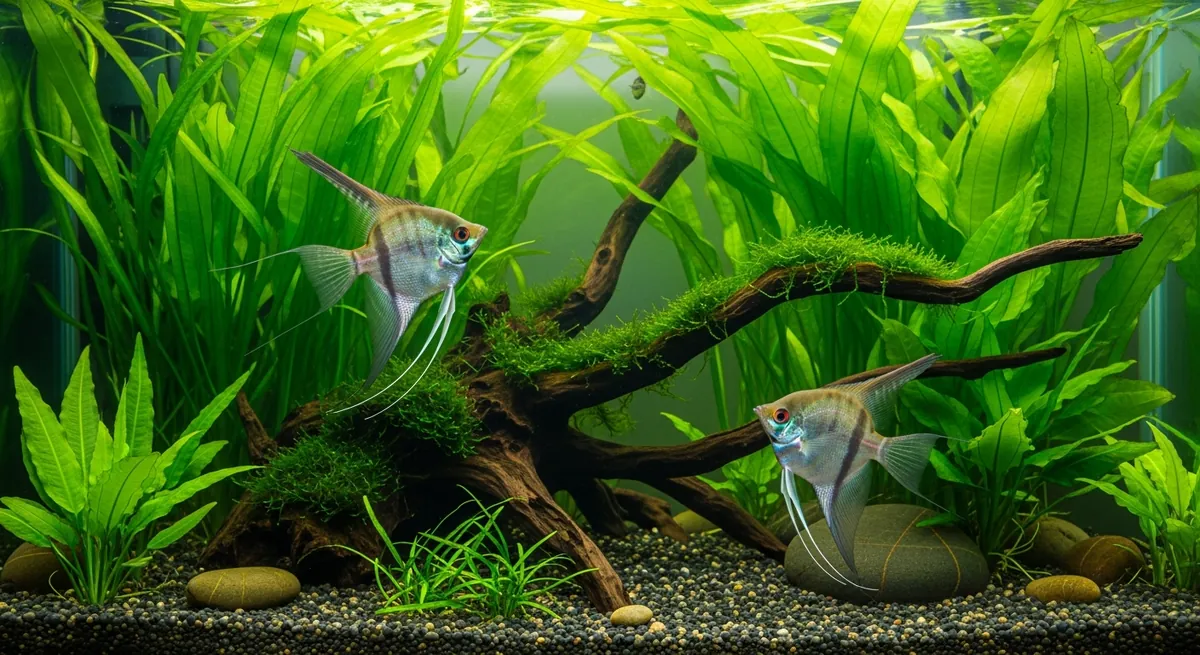
Short answer: Angelfish need at least a 29-gallon tank for one fish. All 5 angelfish setups in our dataset that stated a tank size use tanks over 40 gallons. We checked those 5 real setups to see what sizes people actually pick.
Angelfish at a glance
- Scientific name
- Pterophyllum scalare
- Adult size
- ~6″
- Temperature
- 76–84°F
- pH
- 6.5–7.5
- Minimum tank
- 29 gal
- Temperament
- semi aggressive
- Social
- can be kept singly
- Reference
- Wikipedia
Angelfish need at least a 29-gallon tank. All 5 angelfish keepers in the AquaGauge dataset (July 2026 snapshot) who reported a tank size use tanks over 40 gallons, and a single adult angelfish (Pterophyllum scalare) grows to 6 inches tall with trailing fins that need vertical room most tanks under 29 gallons cannot provide.1
What real keepers actually use
We pulled every angelfish setup in the AquaGauge dataset where the keeper reported tank size and angelfish count. That gave us 5 setups from r/aquariums and r/plantedtank — a small sample, so read these numbers as a snapshot of real keepers, not a survey.
| Tank size | Setups | Median angelfish | Range |
|---|---|---|---|
| Over 40 gal | 5 | 6 | 1-6 |
All 5 keepers who reported tank volume use tanks over 40 gallons. The per-gallon density is low: a median of 0.08 angelfish per gallon. Keepers give angelfish far more space than the bare minimum, and the data reflects that.
Why tank height matters more than length
Angelfish are laterally compressed cichlids. An adult body spans about 6 inches from dorsal to anal fin, and mature fish extend threadlike ventral fins several inches below that.2 A standard 10-gallon (12 inches tall) or 20-gallon long (12 inches tall) physically cannot house an adult.
A 29-gallon standard tank is 18 inches tall, giving an adult angelfish clearance to swim vertically. A 55-gallon (21 inches tall) is better for a group. The aquarium author William T. Innes noted that “Aquaria containing Scalares should be well stocked with large plants. They are very excitable at times and are liable to kill themselves by dashing head-on into the aquarium glass. Plants seem to give them a bearing as to location and prevent this suicidal tendency.”3
Tall planted tanks with Amazon swords or vallisneria give angelfish cover and reduce the darting behavior Innes described.
The bioload math
Each angelfish carries 6.0 bioload units in the stocking calculator. That is the highest load of any common community fish besides goldfish. Here is what each tank size handles:
- 29 gallon: 29 units total. Fits 1 angelfish (6 units) with a school of small dither fish. No room for a pair.
- 40 gallon: 40 units. Fits a pair (12 units) with a school of corydoras or rasboras.
- 55 gallon: 55 units. Fits 4-6 angelfish (24-36 units) with tankmates.
- 75 gallon: 75 units. Room for a full group of 6+ with multiple schools of mid-level and bottom-dwelling fish.
Tankmate warning: angelfish eat small fish
Angelfish are predators. Innes wrote that “P. scalare is not combative, but is fond of eating small fishes that may be swallowed whole.”3 FishBase confirms they feed on smaller fish and invertebrates in the wild.1
This means neon tetras and cherry shrimp are not safe tankmates for adult angelfish. Stick to fish too large to swallow: adult-sized corydoras, harlequin rasboras (borderline), or other medium cichlids like discus (though discus run hotter at 84 F). Use the stocking calculator to check compatibility before mixing.
How we counted
We found 8 angelfish reports in the AquaGauge dataset of 6,414 real tanks compiled from public Reddit fishkeeping posts; 5 of those reports stated a tank size, and those 5 setups are the ones counted above. Keepers self-reported tank size, species, and counts. Full methodology at /methodology/. Figures are from the July 2026 snapshot (6,414 tanks total).
Check your exact stocking
Add your fish below to see stocking %, filtration load and compatibility for your setup — live.
Planning a Angelfish tank. We start with your angelfish and filter the list to compatible tankmates — untick to see every species (incompatible ones get flagged).
Stocking — under 85% comfortable · 85–100% full · over 100% overstocked
Show the math
Gear for this setup
As an Amazon Associate AquaGauge earns from qualifying purchases. Some links below are affiliate links, at no extra cost to you. Current price and availability are shown on Amazon. Disclosure.
 Tetra Glass Aquarium (29 Gallon)A standard 29-gallon with 18 inches of height, the minimum vertical space adult angelfish need.Check price on Amazon →
 hygger Aquarium Heater (200 W)Holds the 78-82 F angelfish prefer, with an intelligent controller and a maker rating of 20 to 40 gallons.Check price on Amazon →
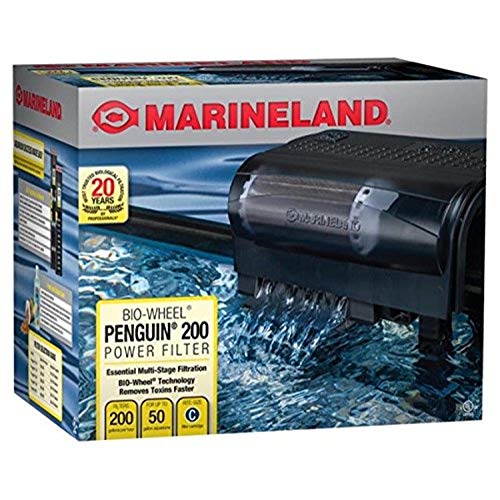 Marineland Penguin 200 GPH Power FilterDelivers 200 GPH for a 29-40 gallon angelfish tank without creating strong current that stresses long fins.Check price on Amazon →
FAQ
- Can angelfish live in a 20-gallon tank?
- A standard 20-gallon is too short for adult angelfish. They grow to 6 inches tall and need at least 18 inches of vertical space. A 29-gallon (18 inches tall) is the practical minimum for a single angelfish.
- Is a 29-gallon tank big enough for angelfish?
- A 29-gallon works for one angelfish kept alone or with small, fast tankmates. Each angelfish carries 6.0 bioload units, so a 29-gallon only has room for one adult plus a few dither fish. A pair needs 40 gallons or more.
- How many angelfish can I keep in a 55-gallon?
- About 4-6. A 55-gallon handles roughly 55 bioload units, and each angelfish adds 6.0. That leaves room for a group of 4-6 with a small school of dither fish. Across the 5 sized angelfish setups in our dataset — all in tanks over 40 gallons — the median count is 6 angelfish.
- Do angelfish need a tall tank?
- Yes. Angelfish are vertically compressed cichlids that reach 6 inches top to bottom. A standard 29-gallon (18 inches tall) is the minimum height. Taller tanks like a 55-gallon (21 inches) give adults room to extend their dorsal and ventral fins.
Sources
- Pterophyllum scalare summary, FishBase. View source ↗
- Pterophyllum scalare, Seriously Fish. View source ↗
- The Complete Aquarium Book.

Freshwater aquarist of 8+ years.