Neon Tetra Tank Mates
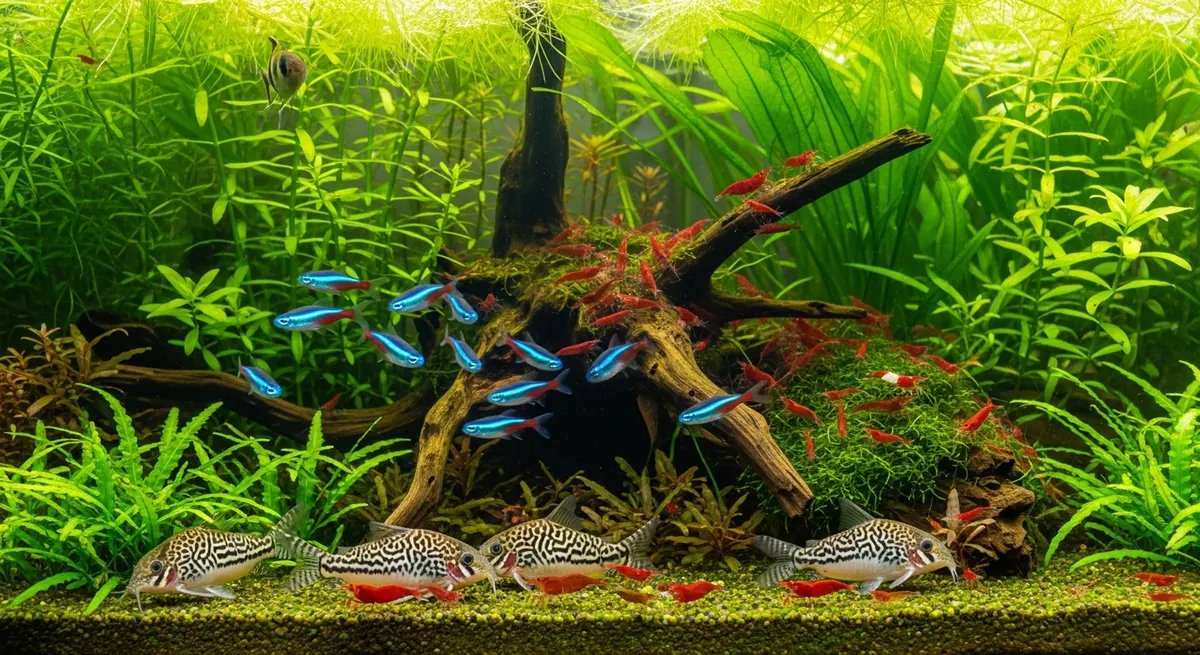
Short answer: The best neon tetra tank mates are other small, peaceful fish that share soft, warm water: corydoras, ember tetras, harlequin rasboras, cherry shrimp, and kuhli loaches. Avoid angelfish, goldfish, and fin nippers.
Neon tetra at a glance
- Scientific name
- Paracheirodon innesi
- Adult size
- ~1.5″
- Temperature
- 70–81°F
- pH
- 5–7
- Minimum tank
- 10 gal
- Temperament
- peaceful
- Social
- schooling — keep 6+
- Reference
- Wikipedia
The best neon tetra tank mates are small, peaceful fish that share soft, warm water: corydoras, ember tetras, harlequin rasboras, cherry shrimp, and kuhli loaches. Avoid angelfish (they eat neons), goldfish (wrong temperature), and fin nippers like tiger barbs.
Neon tetra at a glance
Neon tetra (Paracheirodon innesi); data per Seriously Fish and FishBase.12
| Attribute | Authority | Real tanks (AquaGauge) |
|---|---|---|
| Adult size | 20-30 mm / 0.8-1.2 in1 | --- |
| Temperature | 20-26 C (68-79 F)2 | median 78 F (all 369 tanks reporting temp) |
| pH | 4.0-7.51; 5.0-7.02 | --- |
| Temperament | peaceful; school of 8-10+1 | --- |
| IUCN status | Least Concern2 | --- |
| Key trait | nano (small prey-size fish) | flagged nano in compat model |
"Real tanks" = medians from the AquaGauge dataset (July 2026 snapshot); neon tetras appear in 51 of its tanks — see our neon tetra tank-size data.
The compatibility problem
Neon tetras are peaceful, but their small size (0.8-1.2 inches adult) is the defining constraint. The AquaGauge compatibility model flags them as nano, which means any species tagged fishEater will eat them.
Two traits stack:
-
They are prey. Angelfish, goldfish, and any fish with a mouth big enough to fit a 1.5-inch tetra will eventually eat them. This rules out most medium-to-large cichlids and predatory species.
-
They prefer soft, acidic water. Neons thrive at pH 5.0-7.0 and 70-81 F.12 Livebearers like guppies and platies prefer harder, more alkaline water (pH 7.0-8.2). The overlap is narrow.
The good news: dozens of peaceful community fish share the same soft-water, warm-water niche. The safe list is long.
What the compatibility model shows
We ran every species in the AquaGauge database against neon tetra. The model checks temperature overlap, predation risk (fishEater vs. nano), fin-nipping risk, and pH compatibility.
| Species | Verdict | Why |
|---|---|---|
| Ember tetra | Good | Peaceful nano schooler, 73-84 F overlaps at 73-81 F. pH 5.5-7.0 overlaps well. Same water column, zero conflict. |
| Cardinal tetra | Good | Close relative, 73-81 F overlaps fully. pH 4.5-6.5 overlaps at 5.0-6.5. Schools beautifully together. |
| Harlequin rasbora | Good | Peaceful, 72-81 F full overlap. pH 6.0-7.5 overlaps at 6.0-7.0. |
| Corydoras catfish | Good | Peaceful bottom dweller, 72-80 F overlaps. pH 6.0-7.5 overlaps at 6.0-7.0. Different zone, zero conflict. |
| Pygmy corydoras | Good | Peaceful, 72-79 F overlaps. pH 6.2-7.0 overlaps. Small enough to share a 10-gallon. |
| Kuhli loach | Good | Peaceful, 73-86 F overlaps at 73-81 F. pH 5.5-7.0 overlaps well. Nocturnal bottom dweller. |
| Otocinclus | Good | Peaceful algae eater, 72-79 F overlaps. pH 6.0-7.5 overlaps. Low bioload (0.8 units). |
| Cherry shrimp | Good | Peaceful, 65-80 F overlaps. Neon tetra is NOT fishEater, so adult shrimp are safe. |
| Nerite snail | Good | 65-85 F, pH 6.5-8.5. Overlaps everything. Shell protects from all fish. |
| Mystery snail | Good | 68-82 F, pH 7.0-8.0. Overlaps at 70-81 F and pH 7.0. |
| Bristlenose pleco | Good | Peaceful, 72-82 F overlaps. pH 6.0-7.5 overlaps. Stays on surfaces. |
| Endler’s livebearer | Conditional | Peaceful, 72-82 F overlaps. But pH 7.0-8.0 overlaps only at pH 7.0. Works in neutral water. |
| Guppy | Conditional | Peaceful, 72-82 F overlaps. pH 6.8-7.8 overlaps only at 6.8-7.0. Narrow. Not fishEater, so no predation risk. |
| Platy | Conditional | Peaceful, 70-82 F overlaps. pH 7.0-8.2 overlaps only at 7.0. Very narrow. |
| Dwarf gourami | Conditional | Semi-aggressive. 72-82 F overlaps. pH 6.0-7.5 overlaps well. May harass neons in a small tank. Works in 20+ gallons with plant cover. |
| Betta | Risky | Aggressive. 76-82 F overlaps at 76-81 F. Not fishEater, but aggressive and may attack neons. Hit-or-miss in small tanks. |
| Tiger barb | Bad | finNipper + semi-aggressive. Will harass and stress nano schoolers relentlessly. |
| Serpae tetra | Bad | finNipper. Nips at smaller fish and disrupts schooling. |
| Zebra danio | Bad | finNipper. Semi-aggressive. Also prefers cooler water (64-77 F). |
| Angelfish | Bad | fishEater. Will eat neons. The most common neon tetra tank mate mistake. |
| Discus | Bad | Semi-aggressive, 82-86 F barely overlaps neon range (tops at 81 F). Cardinal tetras are the classic discus companion, not neons. |
| Goldfish | Bad | fishEater + cold water (65-72 F). Double disqualifier. |
The best community build
A neon tetra community works best in layers:
Mid-water: neons + a second schooler. A school of 8-10 neons with 6-8 ember tetras or harlequin rasboras in a 20-gallon tank fills the middle zone with color and movement. Cardinal tetras work too, but mixing two Paracheirodon species looks redundant.
Bottom: corydoras. A group of 6 corydoras occupies the substrate and ignores everything above. They share the 72-80 F, pH 6.0-7.0 range perfectly. This is one of the most reliable pairings in freshwater fishkeeping. See the corydoras care guide for group sizing.
Cleanup: shrimp + snails. Cherry shrimp and nerite snails handle algae and detritus. Neons are not predators (no fishEater flag), so adult shrimp are safe. Dense plant cover protects shrimplets.
Run the stocking plan through the stocking calculator before adding fish. Each neon carries 0.8 bioload units, each corydoras 1.5. A 20-gallon handles 10 neons + 6 corydoras comfortably.
What to avoid
Angelfish are the classic mistake. They are sold alongside neons in pet stores, but adult angelfish eat neon tetras. The fishEater vs. nano conflict is absolute.
Fin nippers (tiger barbs, serpae tetras) do not eat neons but harass them constantly. Stressed neons lose color, stop schooling, and die from secondary infections.
Goldfish fail on two counts: they eat small fish and prefer cold water (65-72 F). See goldfish tank mates for why this never works.
Livebearers (guppies, platies, mollies) are not dangerous but prefer harder, more alkaline water. If your tap runs pH 7.0+ and moderately hard, they can coexist. In soft, acidic setups the livebearers suffer.
How we counted
The compatibility verdicts come from the AquaGauge stocking model, which checks temperature overlap, predation flags (fishEater vs. nano/invert), fin-nipping risk (finNipper vs. longFinned), and pH compatibility across all species in the database. Neon tetra stocking baselines come from the 51 tanks reporting neon tetras in the AquaGauge dataset of 6,414 freshwater community tanks, compiled from public posts across 12 aquarium subreddits, including r/Aquariums and r/PlantedTank. See our full methodology for details. Figures are from the July 2026 snapshot (6,414 tanks total).
Check your exact stocking
Add your fish below to see stocking %, filtration load and compatibility for your setup — live.
Planning a Neon tetra tank. We start with your neon tetra and filter the list to compatible tankmates — untick to see every species (incompatible ones get flagged).
Stocking — under 85% comfortable · 85–100% full · over 100% overstocked
Show the math
Gear for this setup
As an Amazon Associate AquaGauge earns from qualifying purchases. Some links below are affiliate links, at no extra cost to you. Current price and availability are shown on Amazon. Disclosure.
 Hikari Tropical Semi-Floating Micro PelletsSized for small mouths like neon tetras. Semi-floating so mid-water schoolers and bottom-dwelling corydoras both get fed.Check price on Amazon →
 AQUANEAT Bio Sponge Filter (Small, up to 10 gal)Gentle flow that won't blast nano tetras around. Doubles as biological filtration for a peaceful community.Check price on Amazon →
FAQ
- Can neon tetras live with bettas?
- Sometimes. Both prefer 76-82 F and soft water. But bettas are aggressive and may attack neons in a small tank. In a planted 20-gallon with sight breaks, it can work. In a 10-gallon, the odds drop.
- Will angelfish eat neon tetras?
- Yes. Angelfish are flagged fishEater in our compatibility model. An adult angelfish can swallow a 1.5-inch neon whole. This is the single most common neon tetra tank mate mistake.
- Can neon tetras live with guppies?
- Conditionally. Guppies prefer harder, more alkaline water (pH 6.8-7.8) while neons prefer softer, acidic water (pH 5.0-7.0). They overlap only around pH 6.8-7.0. If your tank sits in that range, both do fine.
- How many neon tetras should I keep together?
- At least 6, ideally 8-10. Neon tetras are schooling fish that stress, lose color, and hide when kept in small numbers. Seriously Fish recommends a minimum group of 8-10.
Sources
- Paracheirodon innesi (Neon Tetra), Seriously Fish. View source ↗
- Paracheirodon innesi summary, FishBase. View source ↗

Freshwater aquarist of 8+ years.