Guppy
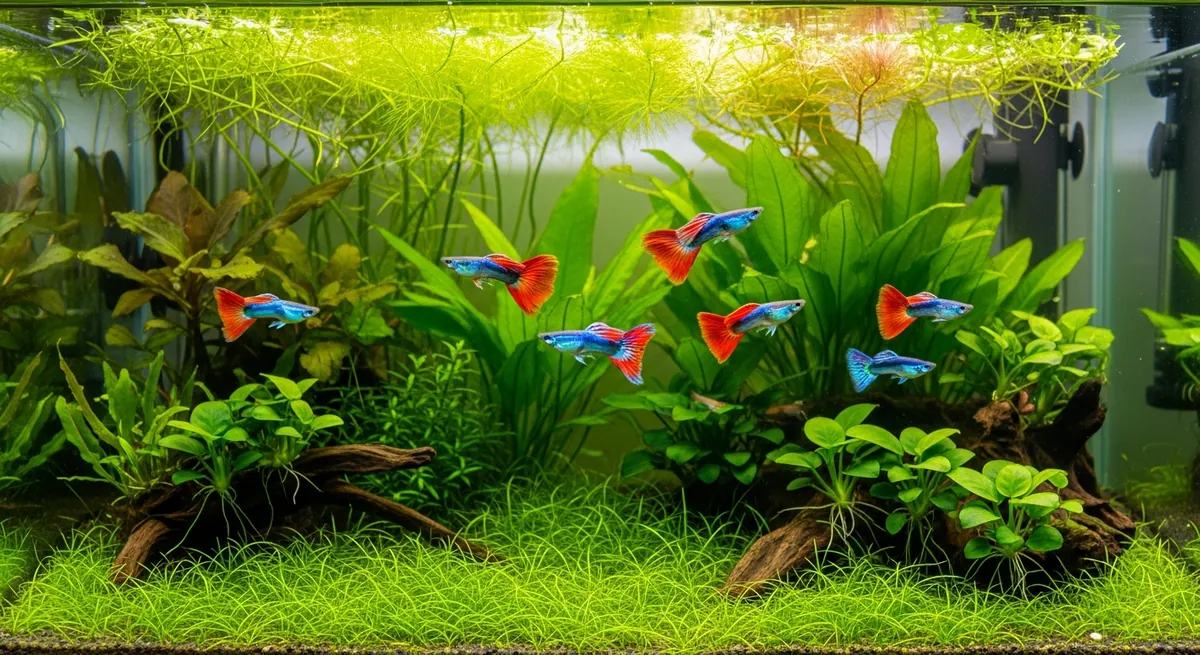
Guppies (Poecilia reticulata) are hardy, colorful livebearers for a cycled tank of at least 10 gallons with hard, slightly alkaline water. They breed constantly, so an all-male group avoids a population explosion.
Guppy at a glance
- Scientific name
- Poecilia reticulata
- Adult size
- ~2″
- Temperature
- 72–82°F
- pH
- 6.8–7.8
- Minimum tank
- 10 gal
- Temperament
- peaceful
- Social
- schooling — keep 3+
- Reference
- Wikipedia
The guppy (Poecilia reticulata) is the classic beginner fish: hardy, cheap, endlessly colorful, and active. The one thing every new keeper learns the hard way is how fast they breed.
Tank and groups
Keep guppies in a cycled, heated tank of at least 10 gallons, in a group of 3 or more. They are social and active. The real stocking question is breeding, not space: a mixed-sex group multiplies quickly. An all-male group of 5–6 stays colorful and stable in a 10-gallon. See how many guppies in a 10-gallon tank for the numbers.
Water
Guppies prefer hard, slightly alkaline water, around 72–82°F and pH 6.8–7.8.2 They tolerate a wide range but do best with stable, mineral-rich water.3 A heater and filter are still required.
Diet
Feed a quality flake or micro-pellet as the staple, with frozen or live brine shrimp and daphnia for color and condition. Small amounts once or twice a day; they will beg constantly.
Breeding
Guppies are livebearers that breed without any effort on your part. One male and a couple of females become 30-plus fish in a few months. If you do not want a population explosion, keep all males, or have a plan for the fry. The classic aquarium author William T. Innes made the same point a century ago: “With most varieties of viviparous (live-bearing) fishes it is desirable to promptly separate the mother from the young in order that they will not be eaten.”1
Temperament and tankmates
Guppies are peaceful, but their bright, flowing tails make them a target for fin-nippers and a trigger for some aggressive fish. See our full guppy tank mates guide for the compatibility model results, including which species are safe, conditional, and dangerous.
Compatible tankmates for Guppy
Generated from our compatibility model — temperament, fin-nipping, temperature overlap and predation. Run your exact plan in the calculator below.
Good companions:Neon tetra, Ember tetra, Cardinal tetra, Harlequin rasbora, Endler's livebearer, Platy, Molly, Corydoras catfish, Pygmy corydoras, Panda corydoras, Bronze corydoras, Sterbai corydoras, Peppered corydoras, Julii corydoras, Otocinclus, Kuhli loach, Dwarf gourami, Angelfish, Cherry shrimp, Nerite snail, Mystery snail, Bristlenose pleco, Common pleco.
Avoid:Zebra danio, Tiger barb, Serpae tetra, Betta.
Plan a Guppy tank
Start with the centerpiece and check stocking, filtration and compatible tankmates — live.
Planning a Guppy tank. We start with your guppy and filter the list to compatible tankmates — untick to see every species (incompatible ones get flagged).
Stocking — under 85% comfortable · 85–100% full · over 100% overstocked
Show the math
FAQ
- How many guppies in a 10-gallon tank?
- About 5–6 adults. Keep them all-male to avoid breeding; a mixed group can turn into dozens of fish in months. See our full breakdown of how many guppies fit a 10-gallon.
- What water do guppies need?
- Hard, slightly alkaline water suits them best, roughly 72–82°F and pH 6.8–7.8. They are hardy but still need a cycled, heated, filtered tank.
- Do guppies need to be in groups?
- Yes, keep at least 3, and ideally more. They are social livebearers. All-male groups stay colorful without breeding; mixed groups multiply fast.
- Are guppies good for beginners?
- Very. They are hardy, active, and cheap, which is exactly why so many first tanks start with them. The main beginner trap is overstocking from uncontrolled breeding.
Sources
- The Complete Aquarium Book.
- Poecilia reticulata (Guppy), FishBase. View source ↗
- Poecilia reticulata – Guppy, Seriously Fish. View source ↗

Freshwater aquarist of 8+ years.