Safe Nitrite Levels in an Aquarium
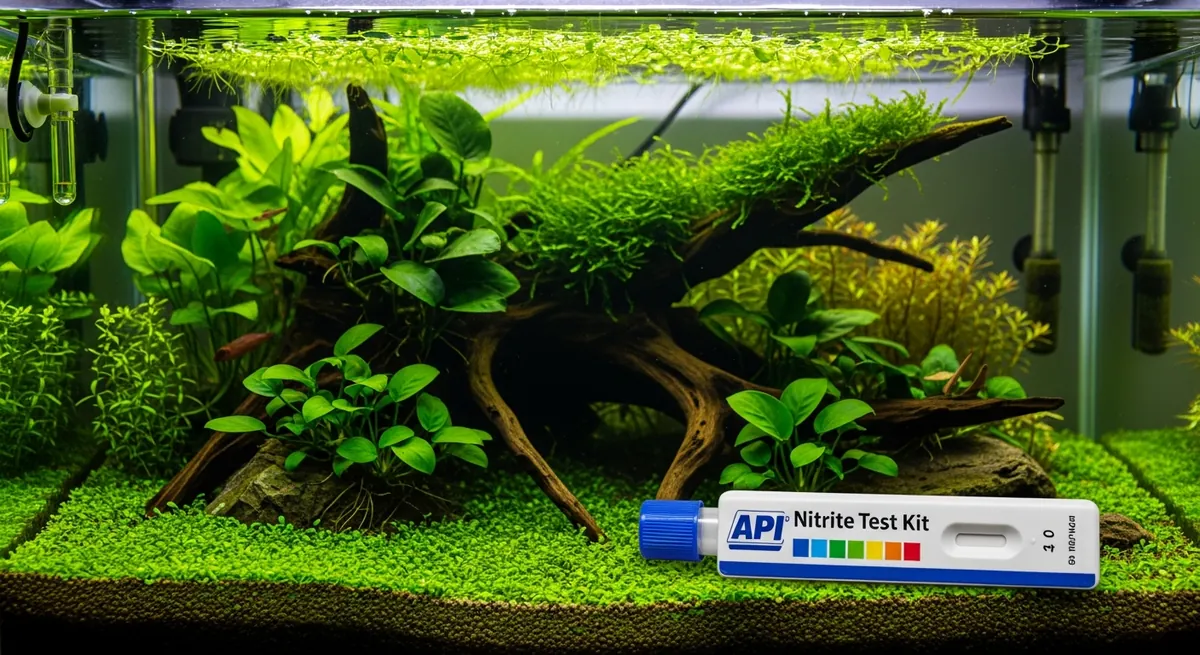
Short answer: Zero. The median nitrite across 733 real freshwater tanks is 0 ppm, and 66% read exactly zero. Any detectable nitrite means the nitrogen cycle is stalled or incomplete.
Zero. The safe nitrite level in any freshwater aquarium is 0 ppm. Across 733 real tanks in the AquaGauge dataset (July 2026 snapshot, drawn from 12 aquarium subreddits), the median nitrite reading is 0 ppm, the mean is 4.2 ppm (pulled up by cycling tanks and crashes), and 66% of tanks read exactly zero.
What real keepers actually measure
Across the 733 tanks with a nitrite reading, 66% sit at exactly 0 ppm and only 34% show any detectable nitrite at all. Three-quarters read at or below 2 ppm (the 75th percentile), so tanks with real nitrite trouble are a minority. The worst reading in the dataset hit 343.6 ppm.
Summary stats (AquaGauge dataset, n = 733): median 0 ppm, mean 4.2 ppm, IQR 0-2, max 343.6 ppm.
The top quarter of readings sit above 2 ppm, almost entirely cycling tanks or emergency posts. That skew is why the mean (4.2 ppm) is so far above the median (0).
By community
| Subreddit | N | Median | Mean |
|---|---|---|---|
| r/shrimptank | 81 | 0 | 2.0 |
| r/bettafish | 101 | 0 | 2.9 |
| r/PlantedTank | 51 | 0 | 3.4 |
| r/aquariums | 71 | 0 | 12.0 |
Shrimp tanks stay closest to zero, averaging just 2.0 ppm. General-aquarium communities show far more variability, and r/aquariums averages 12.0 ppm because those subs attract more cycling questions and troubleshooting posts.
Why nitrite must be zero
Nitrite (NO2) is the second waste product in the nitrogen cycle. Ammonia-oxidizing bacteria convert ammonia into nitrite; nitrite-oxidizing bacteria (Nitrospira) then convert nitrite into nitrate. In a fully cycled tank, nitrite stays at 0 because Nitrospira consumes it as fast as it forms.
Nitrite is toxic because it enters the bloodstream through the gills and binds to hemoglobin, forming methemoglobin. Methemoglobin cannot carry oxygen. Fish suffocate even in well-aerated water. The URI Cooperative Extension notes that nitrite in aquatic systems reduces the oxygen-carrying capacity of blood and is particularly dangerous at low dissolved-oxygen levels.1 Purdue University’s Animal Disease Diagnostic Laboratory describes this as “brown blood disease” because the oxidized hemoglobin turns the blood a rusty brown color visible through the gills.2
At 0.5 ppm you may see gasping at the surface, clamped fins, and brown-tinged gills. Toxicity thresholds vary widely by species: the 96-hour LC50 ranges from as low as 0.6 mg/L for rainbow trout to over 280 mg/L for bluegill. Sensitive species (salmonids, many tetras) can die at concentrations well below 5 ppm; hardier species (cichlids, catfish) tolerate higher concentrations short-term but still suffer sublethal organ damage. Invertebrates (shrimp, snails) are generally less tolerant than fish.
Chloride offers partial protection. Texas A&M AgriLife Extension reports that a chloride-to-nitrite ratio of 16:1 or greater is protective in catfish production, because chloride competes with nitrite for uptake at the gill.3 Most dechlorinated tap water already contains some chloride, but aquarium salt (NaCl) can raise it during a nitrite emergency.
The nitrite spike during cycling
Every new tank goes through a nitrite spike. The sequence:
- Ammonia rises as the first bacteria colony establishes.
- Ammonia drops, nitrite rises (Nitrosomonas is working, Nitrospira is not yet established).
- Nitrite drops to 0 as Nitrospira catches up. Nitrate begins to accumulate.
This spike typically lasts 1-3 weeks. Test daily. If nitrite exceeds 1 ppm with fish in the tank, do a 50% water change and dose a detoxifier.
What to do if nitrite is above zero
- Water change first. 50% immediately if nitrite exceeds 0.25 ppm.
- Dose a detoxifier. Seachem Prime binds nitrite into a non-toxic form for 24-48 hours. It buys time but does not fix the root cause.
- Find the cause. Common culprits: uncycled tank, filter media rinsed in chlorinated water, antibiotic treatment that killed bacteria, prolonged power outage, overstocking.
- Seed the filter. Add mature sponge media from an established tank, or use bottled bacteria (Fritz FritzZyme 7). A seeded filter can drop nitrite to 0 within days.
- Test daily until nitrite holds at 0 for at least a week before considering the tank cycled.
Nitrite vs ammonia vs nitrate
Ammonia and nitrite are both acutely toxic and must be zero. Nitrate is the end product and is tolerated up to 20-40 ppm by most freshwater fish. If your test shows 0 ammonia, 0 nitrite, and some nitrate, the cycle is working. If nitrite is above 0 but ammonia is 0, the second stage of the cycle (Nitrospira) has stalled or is overwhelmed.
For the full ammonia picture, see safe ammonia levels (902 tanks, 69% at zero). For species-specific data, see betta ammonia and nitrate levels or cherry shrimp water parameters.
How we counted
We analyzed 6,414 tank posts from 12 aquarium subreddits where keepers shared water test results. Of those, 733 included a nitrite reading. All numbers on this page come from those readings, verified by verify_stats.py. See examples: source 1, source 2. Full methodology at /methodology/. Figures are from the July 2026 snapshot (6,414 tanks total).
Check your exact stocking
Add your fish below to see stocking %, filtration load and compatibility for your setup — live.
Stocking — under 85% comfortable · 85–100% full · over 100% overstocked
Show the math
Gear for this setup
As an Amazon Associate AquaGauge earns from qualifying purchases. Some links below are affiliate links, at no extra cost to you. Current price and availability are shown on Amazon. Disclosure.
 Seachem Prime (500 ml)Detoxifies nitrite and ammonia on contact, buying 24-48 hours while the biofilter catches up.Check price on Amazon →
 Fritz FritzZyme 7 Live Nitrifying Bacteria (32 oz)Live Nitrosomonas and Nitrospira that seed a new filter and consume nitrite from day one.Check price on Amazon →
FAQ
- What nitrite level is safe for fish?
- Zero ppm. Across 733 freshwater tanks, the median is 0 ppm and 66% read exactly 0. Any detectable nitrite signals a stalled or incomplete nitrogen cycle.
- Is 0.25 ppm nitrite dangerous?
- It is not instantly lethal, but it is not safe. At 0.25 ppm nitrite binds to hemoglobin and reduces oxygen transport. In our dataset, 66% of tanks read exactly zero and only 34% show any detectable nitrite at all.
- How do I lower nitrite fast?
- A 50% water change halves the concentration immediately. Add a dose of Seachem Prime to detoxify nitrite for 24-48 hours while the biofilter catches up. Then find the root cause: uncycled filter, dead stock, crashed bacteria from a filter rinse in chlorinated water.
- How long does the nitrite spike last during cycling?
- Typically 1-3 weeks. Nitrite rises after ammonia-oxidizing bacteria establish but before nitrite-oxidizing bacteria (Nitrospira) catch up. Daily testing and water changes keep fish safe through this phase.
Sources
- Nitrogen and Water Quality, URI Cooperative Extension (2005). View source ↗
- Nitrite Toxicosis In Freshwater Fish or Brown Blood Disease, Purdue Animal Disease Diagnostic Laboratory (1998). View source ↗
- Nitrite Poisoning or Brown Blood Disease — A Preventable Problem, Texas A&M University. View source ↗

Freshwater aquarist of 8+ years.